Things to do in Giethoorn
A village in Overijssel with canals instead of streets, about ninety minutes from Amsterdam. The water is not decorative — it is what is left after eight centuries of digging peat.
- About an hour and a half ab Amsterdam
Why there are canals instead of streets
Giethoorn is not a village that had canals added to it. It is a village that is left over from digging.
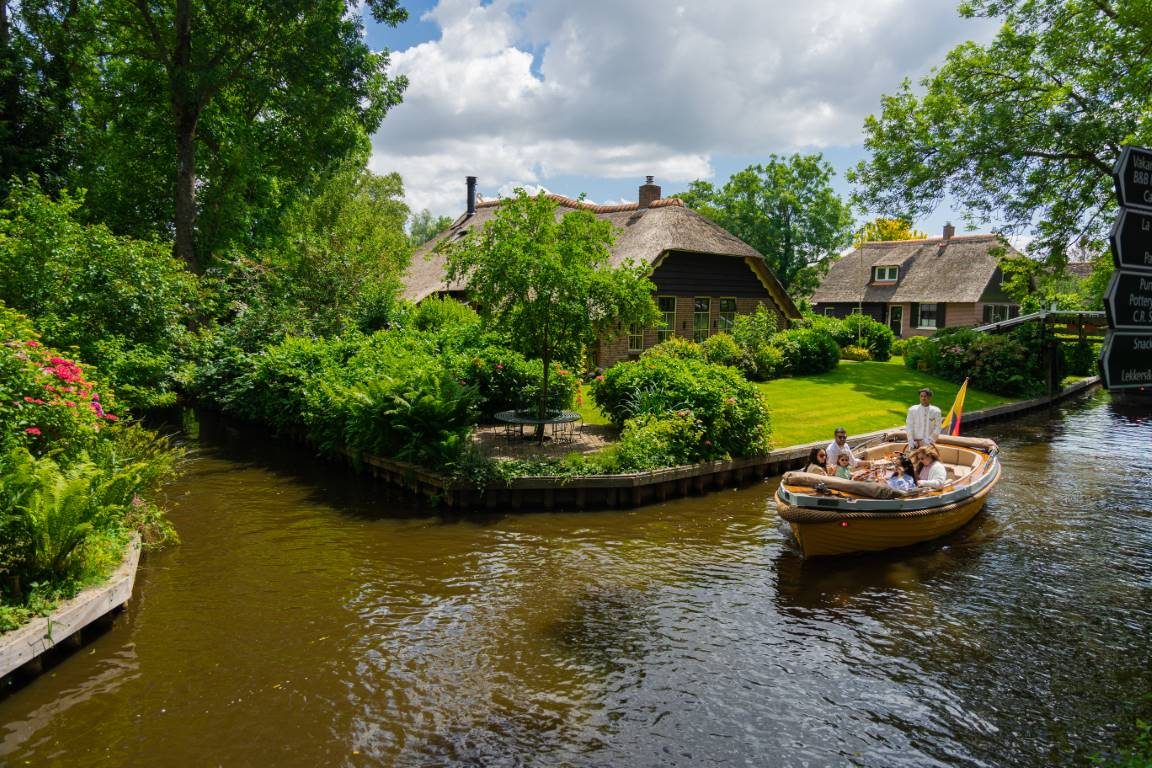
From about the thirteenth century, people here cut peat out of the marsh and dried it for fuel — the only fuel this landscape produced in any quantity. Peat is dug in trenches, and the trenches fill with water. What you are looking at is centuries of those trenches: the canals are the holes, and the strips of land the houses stand on are what was never dug. That is also why every house sits on its own island with a bridge to it. There was no other way to reach the door.
The name is older still and comes from the same ground. Settlers are said to have turned up hundreds of goat horns in the peat, washed there by a flood in the twelfth century — geytenhoren, worn down over time into Giethoorn.
The village stayed obscure until 1958, when the Dutch director Bert Haanstra shot the comedy Fanfare here. It has been busy ever since.
The thing nobody tells you about the crowds
Giethoorn has around 2,600 residents and receives, in a good year, something approaching a million visitors. In July, in the middle of the day, the Binnenpad is shoulder to shoulder and the main canal has a queue of boats on it.
This is entirely avoidable and almost nobody avoids it. The day-trip coaches arrive from about eleven and are gone by four. Before and after those hours it is a quiet village where the loudest thing is a heron taking off.
If you can only come at midday, walk north. The crowd concentrates in the middle third of the village around the restaurants and the boat hire, and it drops away sharply at both ends.
Making the drive worth it
Ninety minutes each way is a real commitment for a village you can walk in an hour, so it is worth building the day out rather than turning straight round.
The obvious addition is the national park the village sits in — De Weerribben-Wieden, a marsh landscape of reed beds and open water that is entirely man-made and now one of the best places for birds in the country. There are walking routes from the north end of Giethoorn straight into it.
The other option is the old Zuiderzee towns on the way back: Blokzijl, a seventeenth-century harbour town ten minutes away that almost nobody stops in, or Vollenhove, which was a port before the water was reclaimed and now sits peculiarly inland.
Was Sie sehen sollten
-
The Binnenpad
The old village path along the main canal — about three kilometres of footway, thatched farmhouses on their own small islands, and a wooden bridge to each front door. No cars can reach any of it.
Tipp vom Fahrer: Walk it in one direction and come back by water, or the other way round. Doing it twice on foot is the common mistake.
-
Getting on the water
The village reads completely differently from a boat, because that is the level it was built for — you end up below the bridges rather than on them, looking up at gardens. Electric boats are near-silent, which is why they are the only kind allowed on much of the water.
Tipp vom Fahrer: A skippered boat is worth the difference if you want to look at the village rather than at where you are steering. It is a narrow, busy waterway.
-
Museum Giethoorn 't Olde Maat Uus
A working farmhouse kept as it was around 1900 — box beds, peat fire, the tools of a family that dug fuel out of the ground and fished the ditches between diggings. It explains the canals better than the canals do.
Tipp vom Fahrer: Half an hour, and it is the answer to "but why is it like this?" — which is the question everyone asks and few places here bother to answer.
-
De Weerribben-Wieden
The national park the village sits inside: the largest lowland peat marsh in northwest Europe, made entirely by human digging and now full of otters, bitterns and marsh harriers. Reed is still cut here commercially for thatching.
Tipp vom Fahrer: Twenty minutes beyond the village and almost nobody who comes for the canals ever sees it. If you have a whole day, this is what to do with the second half.
-
The far end, past the crowds
Giethoorn thins out northward. The stretch beyond the Dominee T.O. Hylkemaweg has the same canals and bridges with a fraction of the people, and the last of it runs out into open reed marsh.
Tipp vom Fahrer: Most visitors turn back at the restaurants in the middle. Keep going for ten more minutes and you get the village most photographs claim to show.
-
The gemstone museum
De Oude Aarde, a private collection of minerals, fossils and cut stones in the middle of the village — unrelated to anything else here and much better than it has any right to be.
Tipp vom Fahrer: This is the wet-weather option. Giethoorn in steady rain is hard work otherwise.
Wo liegt das?
Tagesausflüge, die dorthin fahren
Giethoorn
Das Dorf ohne Straßen. Gleiten Sie im eigenen Boot an reetgedeckten Höfen vorbei, gehen Sie zu Fuß über die kleinen Holzbrücken und sind Sie am Abend zurück in Amsterdam — alles im privaten Minivan mit einem Fahrer, der den Tag um Sie herum plant.
Häufige Fragen
Is Giethoorn really car-free?
The old core of it is. There are no roads to the houses along the Binnenpad — deliveries, moving house and the postman all arrive by boat or by pushing a barrow over the footbridges. The newer part of the village around the main road is ordinary and does have cars.
Do you need to book a boat in advance?
In high summer and on spring weekends it is worth arranging beforehand, because the village can run out of boats by late morning. Out of season you can usually turn up. If we are driving you, we arrange it as part of the day.
How long does Giethoorn take?
The village itself is two to three hours including time on the water. It is the driving that makes it a full day — roughly ninety minutes each way from Amsterdam.
When is the best time to go?
Early morning or late afternoon, and outside July and August if you have the choice. Spring is the best of it: the reed is cut, the water is high and the village is not yet full. Winter is quiet and occasionally the canals freeze, which is when the locals get it back.
Can you take us from Amsterdam?
Yes. It is our most-booked day out and it includes the boat. The price is on this site before you commit to anything.