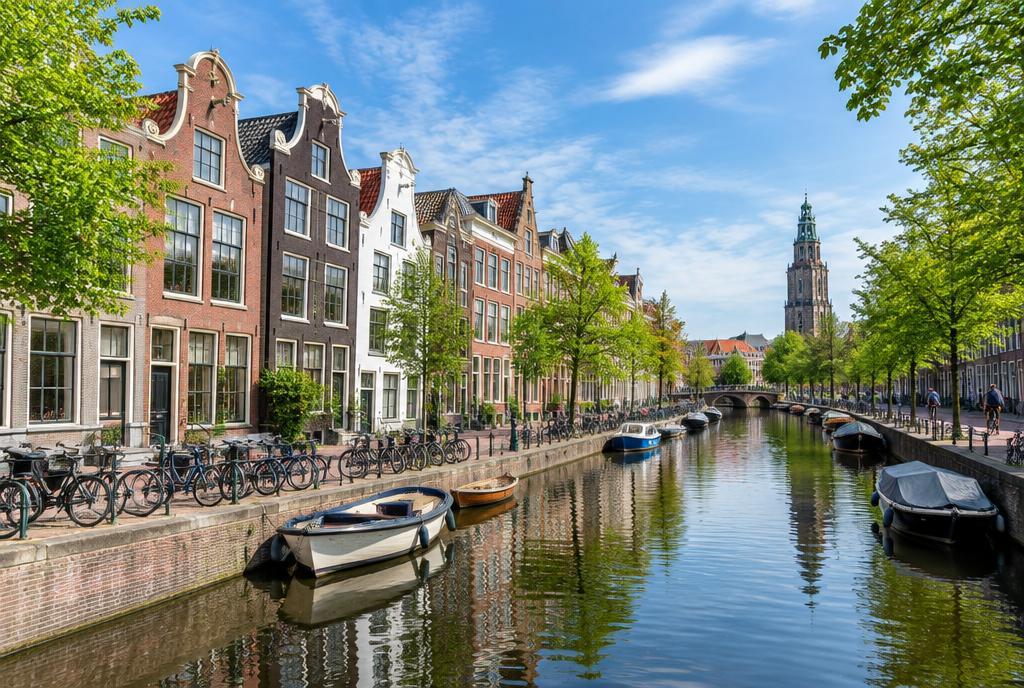
Things to do in Groningen
Groningen is the big city of the north — a Hanseatic port that is now about a quarter students, with a 97-metre tower you can climb, a museum that looks like four architects shared one island, and a centre planned around bikes, not cars.
- About two hours from Amsterdam
The capital of the north
Groningen joined the Hanseatic League in 1284 and for centuries behaved like a city-state, trading across the North Sea and the Baltic and holding sway over the countryside around it. It only became part of the Dutch Republic in 1594, after a two-month siege that took it from Spain, and the university followed in 1614. Both halves of that history are still visible: an old merchant town in the stonework, and a young one on the bikes.
It is the other Netherlands. Not canals and gables, but a big, flat, busy city of about 245,000 people, roughly a quarter of them students, where the visitors are the minority.
Why it feels the way it does
The old centre is small — about twenty minutes on foot from the station to the Noorderplantsoen — and since 1977 it has been run for bikes and pedestrians rather than cars. Much of the Grote Markt was rebuilt after the fighting of April 1945, so the square is a mixture: a medieval tower, the few buildings that survived, and a good deal that went up afterwards.
The Grote Markt, the Martinitoren, the Forum and the museum are all within a short walk of each other, which makes Groningen an easy city to do on foot and an awkward one to do by car. The best of it happens at street level: the market days, the bars along the Poelestraat, an evening in the park. In the rain, the Forum is the answer: next to the tower, free to wander, and home to a library, cinemas, exhibitions and a bar on the roof.
An honest word about the distance
Groningen is about two hours from Amsterdam each way, so a day trip means four hours in the car for six on the ground. That is enough for the tower, the Forum roof, the museum and a proper lunch, and not enough for the evening — which, in a student town, is the better half. If you can, stay a night.
If you do it in a day, the A7 north crosses the Afsluitdijk, the 32-kilometre dam that closed off the Zuiderzee in 1932. It turns the drive into part of the day rather than something to be got through.
What to see
-
The Martinitoren
At 97 metres, d'Olle Grieze — "the old grey one" — is the tallest building in Groningen, and you can climb it: 260 steps, an outside walkway about 39 metres up, and a ten-minute film on the way. It came through the fighting of April 1945 with a bullet hole to show for it.
Driver’s tip: You climb on your own, not on a guided tour, and most people are inside about an hour. Tickets are sold online and at the tourist office in the Forum next door. There is no lift, so be honest about who in the group will manage 260 steps.
-
The Groninger Museum
Opened in 1994 on an island opposite the station, designed by Alessandro Mendini with Philippe Starck, Michele De Lucchi and Coop Himmelb(l)au: a silver cylinder, a yellow tower, a brick fortress and a deconstructivist box in one building. Protesters held up the build for a year; it is now the most-visited museum in the province.
Driver’s tip: The outside is free to judge — it is the first thing you see leaving the station. If you go in, remember that each pavilion was designed for a different part of the collection, so the rooms change character as you move through them.
-
The Grote Markt and the Forum roof
The market square is the middle of the old city. The Martinitoren, the Goudkantoor and the town hall came through the fighting of April 1945; much of the rest of the square did not. A step away, the Forum, a cultural centre that opened in 2019, has a roof terrace 45 metres up.
Driver’s tip: The Forum roof is free, and at 45 metres it is higher than the tower's outside walkway at 39. It also has the Martinitoren in the view, which the tower itself cannot offer, and there is a lift for anyone who needs one. On a clear day you can see as far as Schiermonnikoog.
-
The student streets, and the markets
About a quarter of Groningen is studying — the university dates from 1614 and the Hanze University adds many more — and it shows in the bars along the Poelestraat and Peperstraat and around the Vismarkt. The tone is closer to a working university town than a tourist centre, which is the appeal.
Driver’s tip: The same squares work two shifts. On Tuesdays, Fridays and Saturdays the market fills the Grote Markt, the Vismarkt and the A-kerkhof — around 180 stalls — and by evening the bars take over. Come in term time for the noise; in the summer holidays it is a good deal calmer.
-
A city built around the bike
In September 1977 Groningen split its centre into four sectors and stopped cars crossing between them — a car has to use the ring road, while bikes and pedestrians go straight through. Inner-city motor traffic fell by 44 per cent. Over half of all journeys are now by bike, and the bike park under the station holds more than four thousand.
Driver’s tip: Do not plan to drive across the centre — you can't. Park on the edge or be dropped at the station and walk: the old centre is small and flat, and everything on this page is within about a kilometre of the Grote Markt.
-
The Noorderplantsoen
A landscape park of winding paths and serpentine ponds, laid out on the old ramparts and opened in 1880, now a national monument. It sits just north of the centre, and every August the Noorderzon festival takes it over for eleven days.
Driver’s tip: Walk through it on the way out of the centre rather than making a trip of it. If you are there in August, Noorderzon turns it into a festival village you can walk into for nothing.
Where is it?
Getting there from the nearest airport
The Netherlands Groningen Airport Eelde (GRQ) Get a priceFrequently asked questions
Is Groningen worth a day trip from Amsterdam?
It is a long one — about two hours each way — so you get roughly six hours in the city. That covers the Martinitoren, the Forum roof, the museum and a proper lunch. It does not cover the evening, which is when a student city is at its best, so if you can spare a night, take it.
How long do I need in Groningen?
The centre is small and flat and the sights sit within about a kilometre of each other, so a full day on foot covers them. Add an evening for the bars, and a second day if you want the Wadden Sea coast or the villages around the city.
Can you drive into the centre of Groningen?
Not across it. Since 1977 the centre has been split into four sectors, and a car cannot pass from one to the next — it has to go out to the ring road and come back in. Park on the edge, or be dropped at the station, and walk.
Can you drive us to Groningen?
Yes — we are based in Amsterdam and run private day trips and fixed-price transfers. Groningen is not one of our set day trips, so message us on WhatsApp with the date and how many of you there are, and we will tell you the price before you commit to anything.