Things to do in Maastricht
Maastricht sits in the narrow southern tail of the Netherlands, closer to Liège and Aachen than to Amsterdam, and it shows. Two great churches share one square, a Gothic church is now a bookshop, and the hill to the south is riddled with quarry tunnels.
- About two and a half hours from Amsterdam
Closer to Liège than to Amsterdam
Maastricht is in the far south of the Netherlands, where the country narrows to a tail squeezed between Belgium and Germany. Liège and Aachen are each about thirty kilometres away. It is the capital of Limburg, the long thin province down there, and the local thing to eat is vlaai, a shallow fruit pie on a sweet yeast-dough base. A slice with coffee is a perfectly good reason to sit down.
The name means, roughly, the crossing of the Maas, and the Romans were the first to bridge it. The treaty that created the European Union was signed here in 1992. That is how the name reached most of the world, and it is the least of the reasons to visit.
Getting your bearings
The old centre is compact. The Vrijthof, the bookshop, the Helpoort and the Sint Servaasbrug are all within about ten minutes of each other on foot — the bookshop is two minutes from the square — and across the bridge is Wyck, with the railway station behind it. The casemates are on the western side of the old town.
If you have time for a second church, the Basilica of Our Lady is five minutes from the Vrijthof: one of the most important Romanesque buildings in the country, with a treasury and a statue of Mary, Star of the Sea, dating from around 1400.
The caves are the one thing that needs wheels. They are in the hill to the south, about a kilometre and a half from the Vrijthof, and Fort Sint Pieter, the fortress on the hilltop above them, belongs to the same visitor complex. Take a car or a taxi rather than adding that walk to the end of a long day.
Making a day of it
From Amsterdam it is about two and a half hours each way, so Maastricht is a long day: five hours on the road for a few good ones on the ground. It works if you leave early and choose — the square and the bookshop, one tour underground, a walk over the bridge — and it works better as a night away.
We are based in Amsterdam and drive private day trips and fixed-price transfers across the Netherlands. For a day like this, message us on WhatsApp with your date and where you are starting, and we will tell you the price before you commit to anything.
What to see
-
The Vrijthof
Maastricht's big square, with the Romanesque Basilica of Saint Servatius and the Gothic Sint-Janskerk, its tower painted red, side by side along one edge and café terraces along the rest. Depending on the month it also holds a Christmas market, Carnival or open-air concerts.
Driver’s tip: Climb the red tower of the Sint-Janskerk. It looks straight down onto the square and across the roofs of the old town, and it beats a second coffee on a terrace.
-
The Basilica of Saint Servatius
A Romanesque basilica built over the tomb of Maastricht's first bishop, Saint Servatius, who died in the fourth century. The crypt keeps the tomb, and the treasury holds his reliquary among a remarkable collection of medieval church treasure.
Driver’s tip: Do not stop in the nave. The crypt and the treasury are what the building is famous for, and both are easy to walk past.
-
Boekhandel Dominicanen
A thirteenth-century Dominican church that has been a bookshop since 2006. A three-storey steel bookcase runs between the columns without touching the Gothic vaults, and medieval paintings are still overhead. It is regularly ranked among the most beautiful bookshops in the world.
Driver’s tip: Walk the whole length to the far end, where the altar stood. The coffee bar is there, and you drink it under the vault. The shop is two minutes from the Vrijthof, so it fits neatly between the basilica and lunch.
-
The Helpoort and the casemates
Maastricht spent centuries as a fortress town. The Helpoort, from around 1230, is the oldest surviving city gate in the Netherlands, and a network of tunnels runs beneath the fortifications on the western side of town — dug for defence from the 1570s onwards and used as air-raid shelters in the Second World War.
Driver’s tip: The tunnels are visited only on a guided tour of about an hour, so check the times before you plan around them. The Helpoort holds a small fortress museum and lets you climb up onto the wall.
-
The Sint-Pietersberg caves
The hill just south of the centre has been quarried for building stone for centuries, leaving some twenty thousand passages. People sheltered in them during sieges and in the Second World War, and from 1942 they hid Rembrandt's The Night Watch and hundreds of other works of art.
Driver’s tip: Wear a jacket, whatever the weather: it is 9 to 10°C down there all year. You go in with a guide and a lamp, and the Northern Caves tour includes a full-size copy of The Night Watch drawn in charcoal straight onto the rock.
-
Wyck
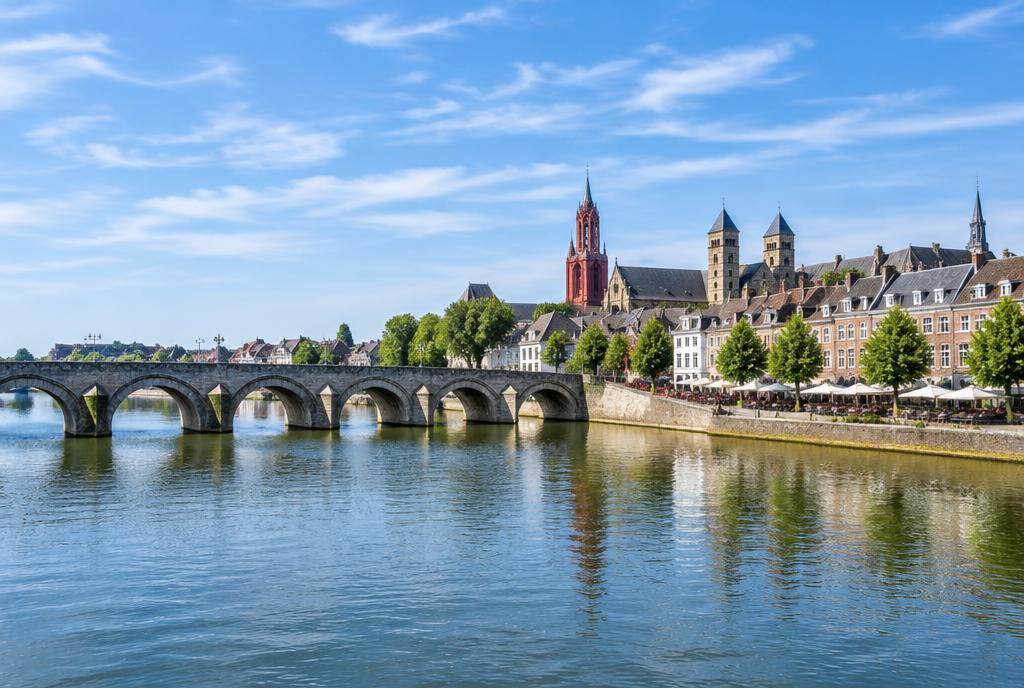
The old quarter across the Maas, reached on foot over the Sint Servaasbrug, a bridge begun in the 1280s that is often called the oldest in the Netherlands, although most of it was rebuilt after the Second World War. Beyond it are narrow streets, small shops, galleries and restaurants.
Driver’s tip: Stop halfway across and look back along the river at the old town. Then take Rechtstraat rather than turning round: it is where Wyck keeps its shops and galleries.
Where is it?
Getting there from the nearest airport
The Netherlands Maastricht Aachen Airport (MST) Get a priceFrequently asked questions
Is Maastricht worth a day trip from Amsterdam?
It is a long one — about two and a half hours each way — but it works if you leave early and keep the plan simple. It is also a natural stop on the way to Belgium or Germany: Liège and Aachen are each about thirty kilometres away.
How long do I need in Maastricht?
A full day covers the Vrijthof, the bookshop, the Sint Servaasbrug and one underground tour. The caves and the casemates are both guided and both take about an hour, and the caves are on the southern edge of town, so unless you start early, pick one.
Why is Maastricht famous?
For the treaty signed here in 1992, which created the European Union and led to the euro. For visitors the draw is the old town itself: a Roman river crossing that became a fortress town, with two great churches on one square and a bookshop in a third.
Can you drive us to Maastricht?
Yes. We are based in Amsterdam and drive private day trips and fixed-price transfers, and Maastricht is on the long side. Message us on WhatsApp with your date and where you are starting, and we will tell you the price before you commit to anything.