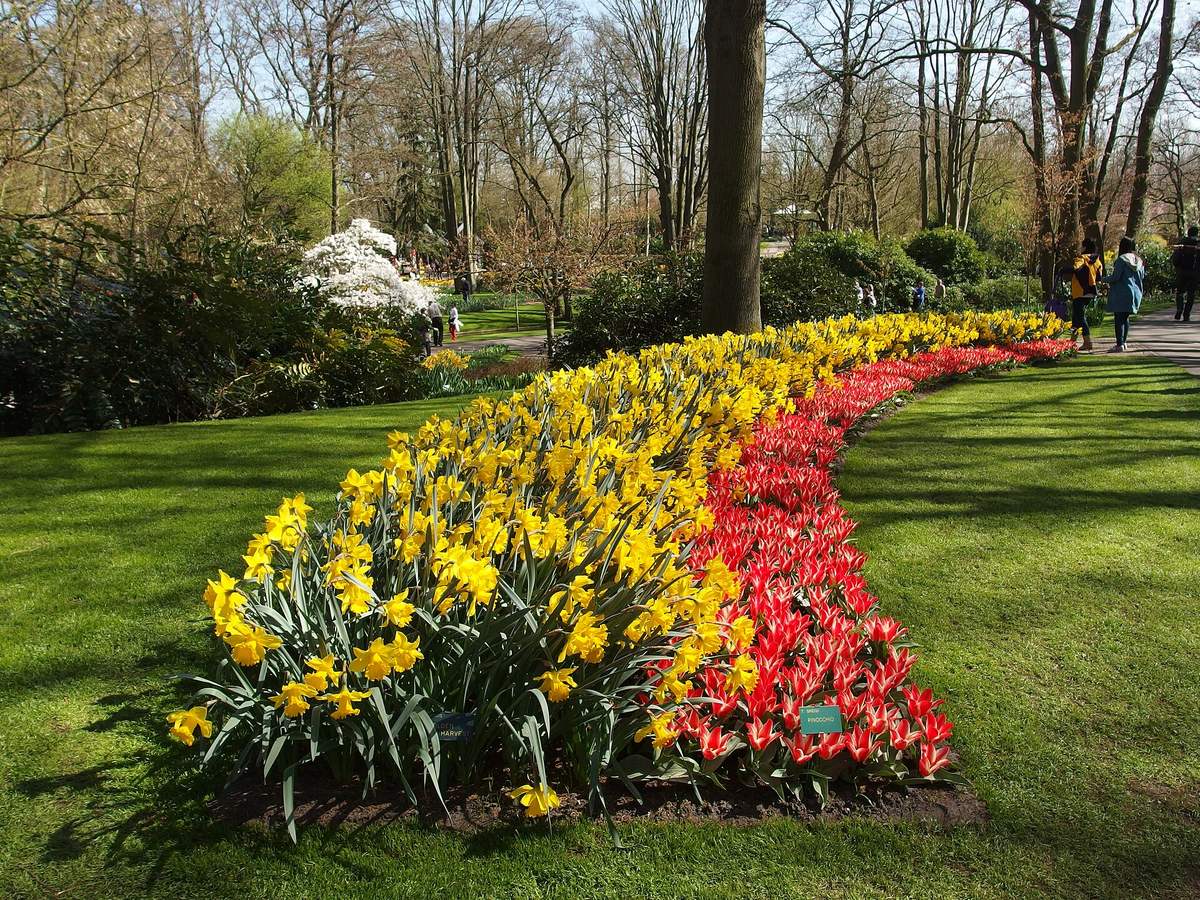
Photo: Guilhem Vellut (CC BY 2.0)
Things to do at Keukenhof and the bulb fields
Seven million bulbs in a wood outside Lisse, open for about eight weeks a year — and the commercial flower fields all around it, which are free, enormous, and not the same thing at all.
- About 40 minutes 암스테르담에서
Two different things with one name
Almost every disappointed visitor to the bulb region has made the same mistake, so it is worth getting straight first.
Keukenhof is a landscaped garden: thirty-two hectares of woodland, lawn and water, planted every autumn with millions of bulbs in mixed drifts and pavilions. It is beautiful and it is deliberately varied — you get hundreds of cultivars, in combinations, under trees.
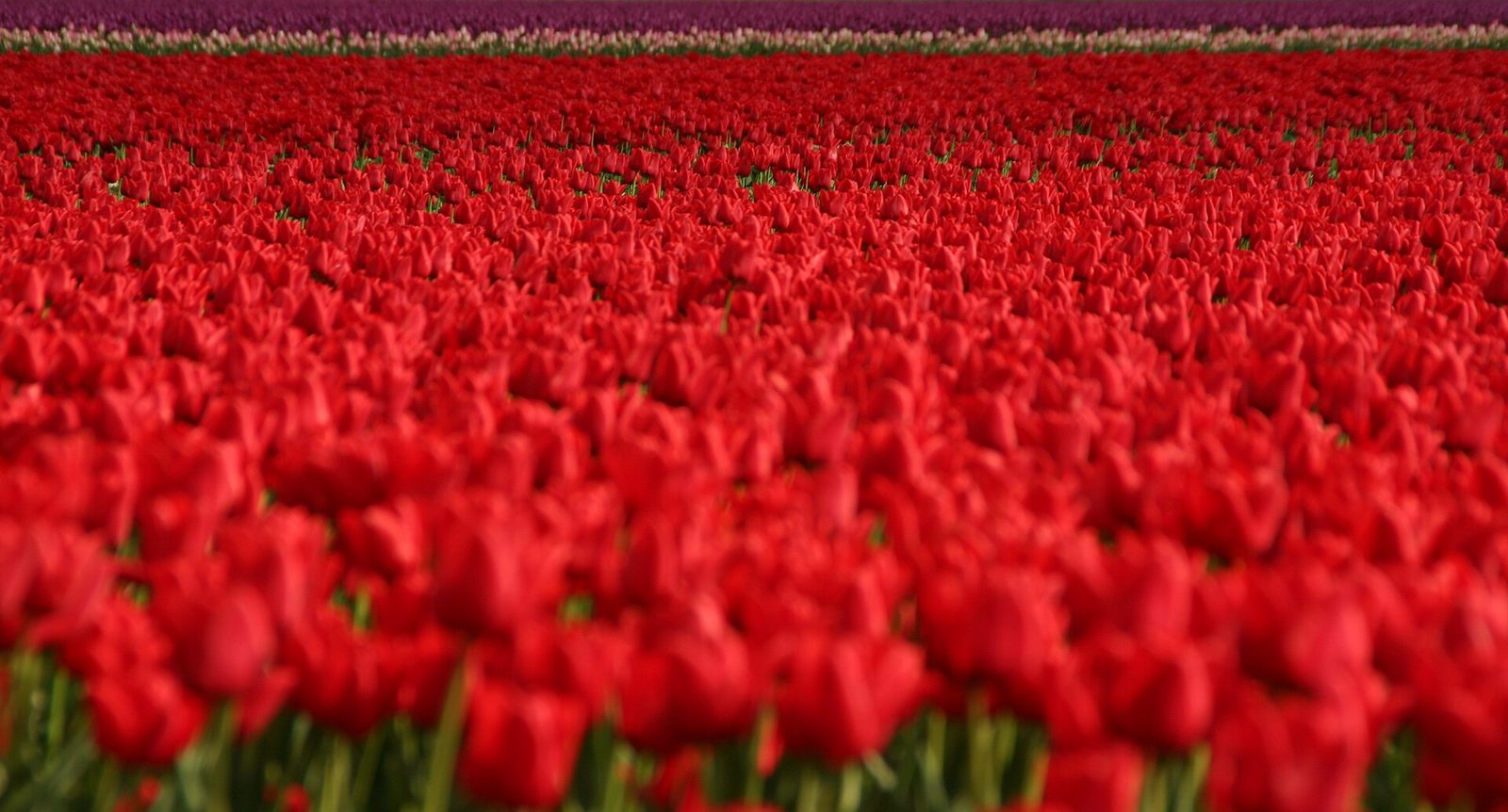
The bulb fields are farmland. They are the flat, saturated blocks of single colour that appear in every photograph of the Netherlands in spring, and they are not in the garden. They are in the working countryside around Lisse, Hillegom, Noordwijkerhout and Sassenheim — free, unfenced, visible from any road, and growing a crop.
Both are worth your time. They are simply not in the same place, and a visit that only goes through the turnstile misses half of what people came for.
The crop is the bulb, not the flower
The fields look like they are grown for their appearance. They are not. The Netherlands exports something in the order of two billion bulbs a year, and the flower is a by-product of growing them.
Which is why, at some point in the season, the growers come through and cut the heads off. Removing the bloom pushes the plant’s energy back down into the bulb, which is the thing being sold. A field that was solid red on Tuesday can be green on Thursday.
That is also why nobody can promise you a particular field on a particular day. Bloom depends on the winter, the variety and the grower’s schedule, and it moves by a week or two from year to year. Come in the middle of the season rather than at the edge of it and you are giving yourself the best odds.
Getting the timing right
The season runs roughly from the third week of March to the middle of May, and inside that there is a clear shape: crocus and early narcissi at the start, hyacinths and daffodils through early April, tulips at their strongest from about the middle of the month.
The other half of the timing is the hour. Keukenhof takes over a million people in eight weeks and the coaches concentrate between about ten and three. The first hour after opening and the last two before closing are quieter, and the late afternoon has the better light for the fields on the way home.
볼거리
-
The garden itself
Thirty-two hectares of woodland and water planted with something like seven million bulbs, laid out in drifts under mature trees rather than in blocks. It is a showcase, built in 1950 so that Dutch growers had somewhere to display to buyers, and it is still partly that.
기사의 한마디: Go anticlockwise from the main entrance. Almost everyone turns right, and the far side of the lake stays noticeably quieter for the first hour.
-
The fields outside the gates
The stripes of solid colour people picture are not inside Keukenhof — they are the commercial fields all around Lisse, Hillegom and Noordwijkerhout. Those are free, they are vast, and they run right up to the roadside.
기사의 한마디: Never walk into a field. It is somebody's crop, the bulbs bruise underfoot, and the growers are patient but not infinitely so. The verge gives you the same photograph.
-
The windmill inside the park
A 1892 mill moved here from Groningen, with a viewing platform at the top. From it you look out over the working fields behind the garden — the one place inside Keukenhof where you see the industry rather than the display.
기사의 한마디: The queue for the platform is short first thing and long by noon, and the view is better in the morning light anyway.
-
Museum de Zwarte Tulp
In Lisse village, a small museum about the bulb trade itself: how tulip mania actually worked, how a bulb is grown, graded and shipped, and why the black tulip does not exist.
기사의 한마디: This is the wet-day answer, and it is a five-minute drive from the garden.
-
The Bloemencorso flower parade
A parade of floats built entirely from cut hyacinths and tulips that runs forty kilometres from Noordwijk to Haarlem over one weekend in late April, passing straight through Lisse.
기사의 한마디: The floats are parked and lit in Noordwijk the evening before and in Haarlem the day after, which is a calmer way to see them up close than standing in the crowd.
-
Kasteel Keukenhof
The estate the garden takes its name from — a country house whose kitchen garden, the keukenduin, fed Jacoba of Bavaria's castle at Teylingen in the fifteenth century. The grounds are open and are a different, quieter kind of green.
기사의 한마디: Separate entrance and separate ticket from the flower garden. Worth it only if you have time to spare.
어디에 있나요?
이곳에 가는 일일 투어
Keukenhof & tulip fields
Seven million bulbs in one garden, and stripes of colour running to the horizon in the fields around it. A spring-only day, and the one that books out first — from mid-March to mid-May.
mid-March to mid-May
자주 묻는 질문
When is Keukenhof open?
For roughly eight weeks each spring, generally from around the third week of March to the middle of May. The exact dates are set year by year, so check before you plan travel around it — it is closed for the other ten months.
When are the tulips actually out?
The garden is planted in layers so that something is always flowering across the season: crocus and early narcissi first, then hyacinths and daffodils, with tulips strongest from about mid-April. The fields outside run later than the garden inside.
Is the garden the same as the tulip fields?
No, and this catches a lot of people out. Keukenhof is a landscaped park of mixed planting. The solid blocks of colour are commercial fields in the surrounding countryside, free to see from the road, and at their best for a shorter window.
How busy does it get?
Very. It receives well over a million visitors in eight weeks, and weekends in late April are the peak of the peak. A weekday, at opening or after about four in the afternoon, is a different experience entirely.
Can you drive us there?
Yes — we run a private day in the season that takes in the garden and the fields around it, at a price agreed before you book. Outside the eight weeks there is no garden to visit, and we will say so rather than sell you the drive.